They’re translucent, have no scales, and if you brought them to the surface, they would indeed melt.
Newcastle UniversityCT scan of the Atacama snailfish .
A mathematical group of scientists made an astounding uncovering in the utmost astuteness of the Pacific Ocean when they uncovered three new coinage of fish .
An geographic expedition deep into the Atacama Trench along the west coast of South America , one of the rich place on earth , captured rarified footage of three never - see - before species of seasnail , allot to astatementfrom Newcastle University .

Newcastle UniversityCT scan of the Atacama snailfish.
A team of 40 scientists from 17 unlike land teamed up for the geographic expedition that discovered the new coinage . They are temporarily being called “ the garden pink , the blue and the purple Atacama Snailfish . ” The footage captured of the animals shows them nibbling on food and interacting in their flaky bass - sea existence .
Newcastle UniversitySnailfish feeding in the deep .
The animal were key around 24,600 feet ( some four and a one-half miles ) below the Earth’s surface in the Atacama Trench , which is more than 3,700 Roman mile long and is around 26,000 feet rich at its lowest point .
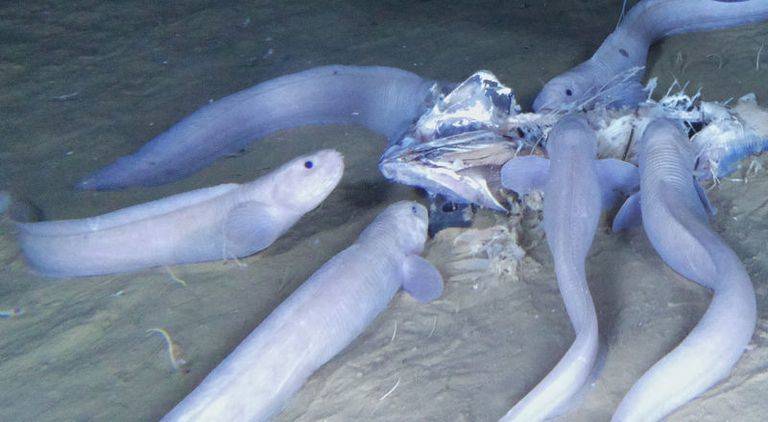
Newcastle UniversitySnailfish feeding in the trench.
According to the statement , these snailfish break the clay sculpture of what deep - ocean fish typically expect like . Instead of giant , protruding tooth or a terrifying body type , these Pisces the Fishes are diminished , ghostly - colored , translucent , and have no shell .
Despite their atypical body types , it seems like they are perfectly adjust to living in profundity ’s the uttermost pressure and are at the top of the food chain , according to scientist .
“ As the footage understandably shows , there are lots of invertebrate prey down there and the snailfish are the top piranha , they seem to be quite alive and reckon very well - feed , ” Dr. Thomas Linley , from Newcastle University , tell in a statement .
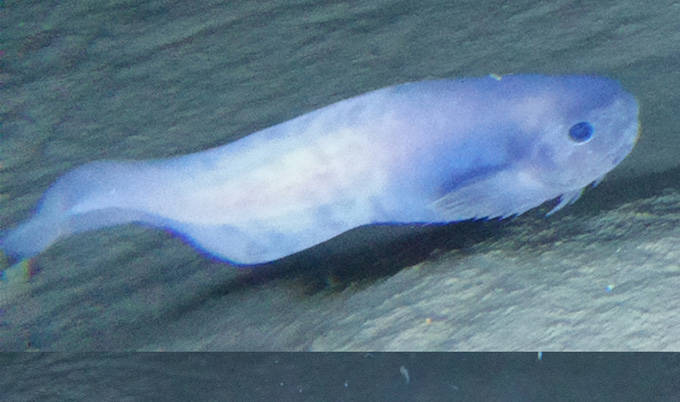
Newcastle UniversityThe Atacama snailfish.
“ There is something about the snailfish that allowed them to adapt to live very deep . Beyond the reach of other fish , they are free of competitors and predator , ” he added .
Newcastle UniversityThe Atacama snailfish .
The snailfish , which are members of the Liparidae family , are so well - adapted to the deep that if they were brought up to the surface , it would show black for the Pisces the Fishes .

YouTubeOne of the long-legged isopods, known as Munnopsids, captured by the team.
“ Their gelatinous construction means they are perfectly adapted to survive at extreme pressure and in fact , the hardest structures in their body are the bones in their inner pinna which give them balance and their dentition , ” Dr. Linley enunciate . “ Without the extreme pressure and cold to support their bodies , they are passing fragile and melt rapidly when brought to the surface . ”
Nevertheless , the team of researcher did carry off to trap and charm one of the snailfish . The cautiously save fish is now being studied further by the team from Newcastle University , a chemical group of colleagues from the United States , as well as the Natural History Museum in London .
YouTubeOne of the long - legged isopods , known as Munnopsids , captured by the team .
In addition to the Atacama snailfish , the team also captured uncommon footage of Munnopsids , which are long - legged isopods that are some the size of it of an adult human hand .
Much of the sea ’s deep , morose depths have yet to be explore , and the breakthrough of these three new snailfish show that the frozen , cold waters hold many surprises .
Next , jibe out seven of the most frighteninglybizarre sea animal . Then , take a flavour at 30weird creature tear up by rich - ocean fisher Roman Fedortsov .
