An outside collaboration of uranologist is reporting on the discovery of between 70 and 170 rogue major planet , in what is an unprecedented scientific achievement .
Rogue planets are as creepy as they are mysterious . float through the sorry expanse of interstellar blank , these planets are without host star , having either departed their star system of origin or never have a star system of line of descent in the first position . Astronomers first learned about loose - floating planets in the 1990s , but many unrequited questions remain , such as the conditions under which they form , their size and composition , and their relative abundance in the beetleweed .
Research published today inNatureis moving the acerate leaf forward on these astronomical matters , as a squad of scientist has spotted upward of 170 varlet planet in a nearby region of the Milky Way known as the Upper Scorpius OB stellar connexion ( by “ nearby ” we ’re babble about 420 sluttish years away ) . This effectively doubles the full number of known free - float planets — a mark that the full population of rogue planet in our wandflower is huge . Indeed , the total act of rogue planet surmise of lurking in the Milky Way would ’ve made the former Carl Sagan very gallant , as it likely numbers in the 1000000000000 and billions — and possibly in thetrillions .

Artist’s impression of a rogue planet.Image: NOIRLab
The newly detected scalawag major planet were notice in nearly 20 years ’ worth of astronomic data point , include observations gather by the European Southern Observatory , the Canada - France - Hawaii Telescope , the Subaru Telescope , and ESA ’s Gaia satellite . Hervé Bouy , an stargazer at the University of Bordeaux and the labor drawing card , said datum made uncommitted through the extensiveNOIRLab Astro Data Archivewas “ central to this report , ” as he explained in a NOIRLabstatement .
In an email , Núria Miret - Roig , an stargazer at the University of Bordeaux and the first author of the new study , say the newfangled workplace cover an “ extremely large area in the sky , ” approximately 170 degrees solid , which is much larger than old surveys . “ This has been possible thanks to the compiling of all the images useable in public archive together with our own observation , ” she said . The wonderful amount of data—80,000 image totaling 100 TB — ask the team “ to combine innovative statistical tools with data minelaying techniques . ”
A fundamental aspect of the study was the proficiency used for spotting rogue major planet . Detecting loose - floating planets is challenging , as they ’re not associated with a host star and it ’s not immediately obvious where they ’re located in the vastness of space . The traditional approach to detect rogue planets , microlensing , depend onchance alignmentsbetween a rogue planet and an unrelated screen background star . The trouble with microlensing is that they tend to be one - off events , and the rogue satellite is likely to never be see again . The unfitness to study an exoplanet for an prolonged period of time represents a Brobdingnagian limitation .
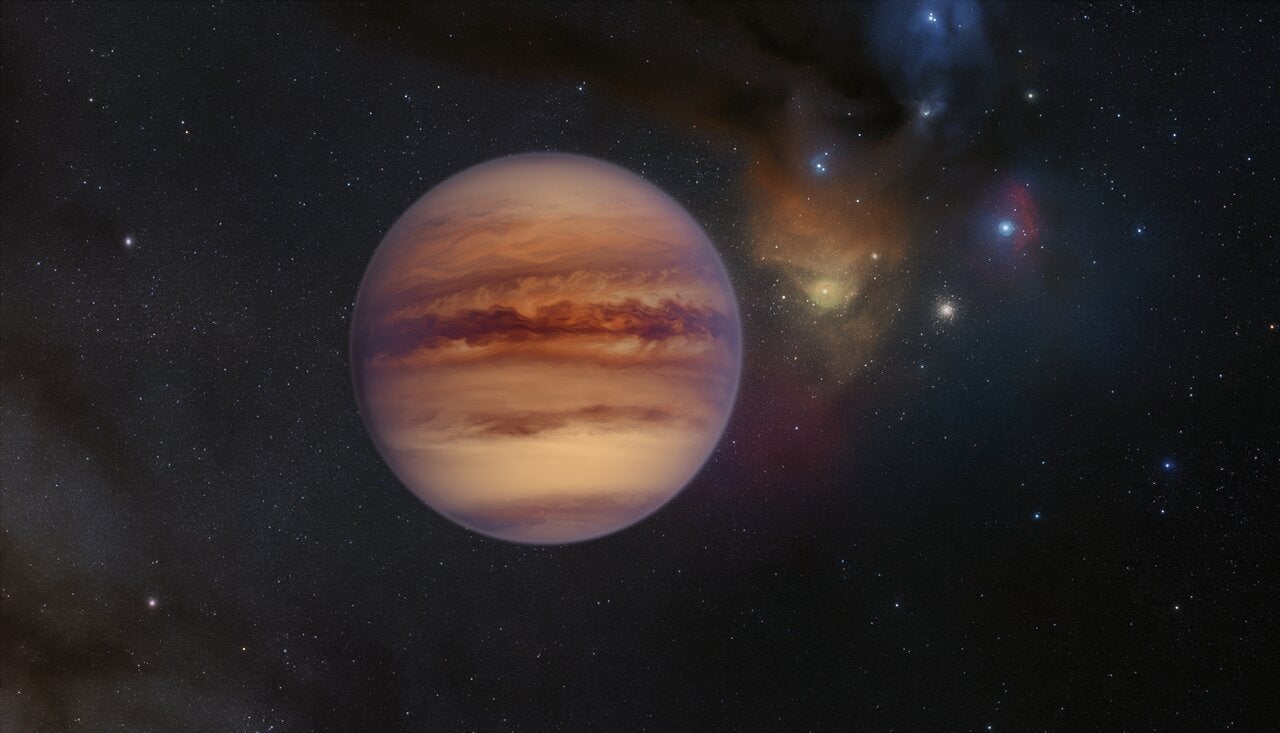
Artist’s impression of a rogue planet, also known as free-floating planets.Image: ESO/M. Kornmesser
An exciting facet of the unexampled study is that the newly detected rogue planets can be studied in the hereafter . Miret - Roig and her colleagues worked under the presumption that some rogue planets , having constitute only a few million years ago , are still piping red-hot , and as such are directly detectable by telescopes . For the study , the squad pored over those 80,000 spacious - field images , measure the Inner Light across a reach of optical and near - infrared wavelength . The team also measured the tiny move made by the objects , which they did to further re - affirm them as planets zipping around blank space without hosts .
As many as 3,455 candidates were identified , of which 70 to 170 Jupiter - size objects were deemed to be true rogue exoplanets . The uranologist could not pinpoint an exact act due to uncertainties receive to do with the presume age of the neighborhood and the mass of the objects .
“ We were able to infer individual masses by comparing the luminance of each planet with theoretical models . The primary difficulty is that planets are comparatively shiny when they are young and they quickly fade with time , ” explained Miret - Roig . “ Then , if the age of the planet is not exactly known — which is the example in our sample — it is hard to separate an honest-to-goodness massive satellite from a younger but less massive one . ”

A succeed - up field of study to valuate the accurate age and mass of these presumed rogue exoplanets is planned , as are some spectroscopic observations to “ determine other physical properties such as the effective temperature and the typography , ” she said . Future observatories , such as with the upcoming Webb space telescope , the Extremely prominent Telescope ( ELT ) , and Vera C. Rubin Observatory , could further validate these effect .
Another exciting aspect of this study is what it ’s telling us about the conditions under which rogue satellite form . Two theories aim to explain how planets like this come into beingness . They either form from protoplanetary magnetic disk around host stars and then get booted out into interstellar outer space , or they form from the flop of flatulence clouds that are too little to form stars .
Miret - Roig said the total issue of stray objects observed in the new study “ exceeds the bit of free - floating planet expect if they only mold like stars from the collapse of a small molecular cloud , indicating that other mechanisms must be at play . ” Astronomers , therefore , “ can say that both mechanisms must be at oeuvre , and that the contribution of ejection to the final universe must be substantial . ”

break that scalawag planet are in all likelihood produced by both process , the total number of rogue planet should be Brobdingnagian . Like Carl Sagan huge . Thanks to those forthcoming follow - up studies and next scope , we should gestate to memorize a lot more in the issue forth year .
More : Rogue major planet can form without a parent star .
AstronomyExoplanetology

Daily Newsletter
Get the good technical school , skill , and culture news program in your inbox daily .
News from the hereafter , delivered to your present .
You May Also Like


