When you buy through links on our site , we may realise an affiliate charge . Here ’s how it exercise .
Scientists late scooped up one of the heaviest meteorites ever discovered inAntarctica , as well as four other frozen blank space rocks that likely break up into the gelid continent thousands of yr ago .
The researchers get hold the minihoard of meteorites on the surface of the Nils Larsen blue ice zone near the Belgian - have Princess Elisabeth Antarctica post . Of the five meteorite , the standout was a cantaloupe - size sway that weigh a whopping 16.7 pounds ( 7.6 kilograms ) . Of the 45,000 meteorites discovered in Antarctica , only around 100 have been as heavy as this cosmic cannonball .

The expedition team pose next to the massive new meteorite. The researchers are Maria Schönbächler (white helmet), Maria Valdes (green helmet), Ryoga Maeda (black helmet) and Vinciane Debaille (orange helmet).
" Size does n’t needfully count when it comes to meteorites , and even petite micrometeorites can be incredibly scientifically valuable , " hostile expedition scientistMaria Valdes , a meteoriticist at the Field Museum in Chicago , said in a pressstatement . " But of course , finding a big meteorite like this one is uncommon , and really exciting . "
Related : Mars meteorite that crashed to Earth control ' vast diversity ' of organic compounds
The meteorites were found on the surface of the trash in other January , but they did not crash to Earth of late . Instead , the space stone were in all probability buried in the shabu for thousands of years and resurfaced only after the moil gesture of glacier brought them back to the surface . But because the meteorites were shield from precipitation , malarkey and air beneath the glass , they were still perfectly intact , accord to the researchers .
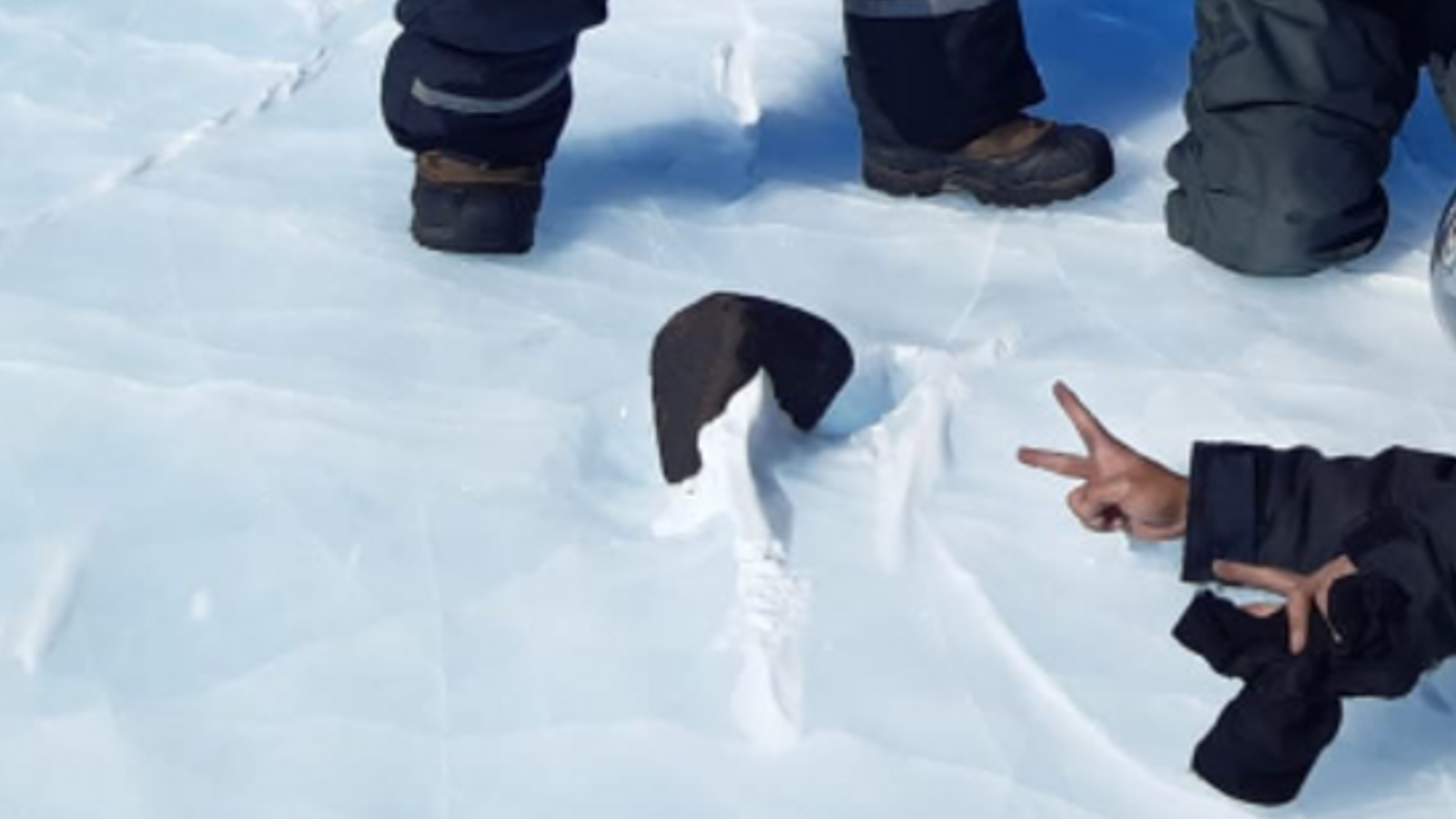
A closer look at the 16.7-pound meteorite.
" The object come from the asteroid belt [ located between the reach of Mars and Jupiter ] and probably plonk down into the Antarctic patrician ice several ten-spot of thousands of eld ago , " sashay scientistRyoga Maeda , a doctorial pupil at the Free University of Brussels , differentiate Belgian news siteThe Brussels Times .
commonly , scientists have to scrub the ice sheets in hopes of stumbling across a meteorite . But the investigator were able-bodied to contract down their search thanks to a study published Jan. 26 , 2022 , in the journalScience Advances , which used planet data and a type of hokey news address car get word to describe parts of Antarctica where meteorite clusters were more likely to be bring to the surface . It was in one of those hotspots that the newfound meteorites were discovered .
But even with a specific location to hunting , it still took a lot of surd work to line up the meteorite . " The reality on the terra firma is much more hard than the beauty of orbiter figure of speech , " conduct expedition scientistVinciane Debaille , a geochemist at the Free University of Brussels , tell in the program line .

An artist’s interpretation of a meteor shower hitting Earth.
The team covered a large field , which was strewn with other non - meteorite rock of similar shape and size . The researchers were constantly dissipate by " meteoroid - wrong , " which bet similar to infinite rock but were much weak and originated on Earth , CNNreported .
concern : How many meteorites hit Earth every class ?
The meteorite samples collected during the expedition have been sent to the Royal Belgian Institute of Natural Sciences in Brussels to be decent thawed and analyse , but each sashay scientist also took back samples of likely meteorite dust , which they collect from around the fallen quad rocks , for their own research , according to the statement .

— Never - before - seen crystal find in absolutely preserved meteorite dust
— Astronomers design to angle an interstellar meteorite out of the ocean using a massive magnet
— Two minerals never determine before on Earth found inside 17 - ton meteorite

The expedition was the first to search one of the likely meteorite hotspots spotlight by the 2022 orbiter study . The team ’s achiever hint that the study could be used by other researchers to recover even more frozen meteoroid fragments . In the written report , researchers judge that as many as 300,000 meteorite could lie in wait on the control surface of the ice rink , meaning only around 15 % have been recover to date .
The sashay squad hope more meteorites can be establish to assist us learn more about our cosmic neighborhood .
" study meteorites helps us well understand our place in theuniverse , " Valdes said . " The swelled a sample size we have of meteorite , the better we can empathise oursolar organisation , and the better we can understand ourselves . "